
An editorial by Patrick Duss, President of the ORIPA Pickleball Association (2021–2025), Indio, California
Pickleball is at a historic turning point. What was considered a niche sport just a few years ago is now evolving into a global movement. Millions of people are discovering our sport, new clubs are springing up, national federations are being founded, and international tournaments are steadily gaining in importance. This growth is fascinating—but it also comes with responsibility.
If you want to build a global sport, you need common standards.
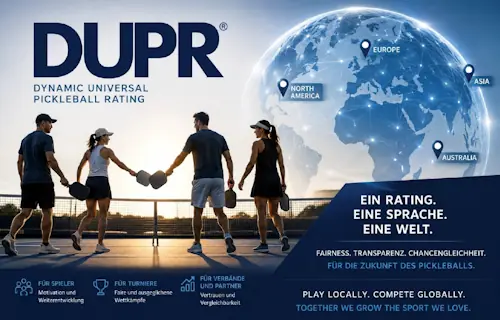
This is exactly where DUPR—the Dynamic Universal Pickleball Rating—comes into play. DUPR is much more than just a ranking system. It is the foundation for fairness, transparency, and credibility. It creates a common language for players on every continent and connects local clubs with the international pickleball community.
At a time when pickleball is transcending national borders, it is no longer sufficient to use different rating systems within individual regions. A player from California should be rated using the same objective criteria as a player from Switzerland, Japan, or Australia. Sports thrive on comparability—and comparability requires a common standard.
Of course, there will always be discussions about individual calculations or results. No dynamic rating system can perfectly capture every individual case. But we must not make the mistake of letting perfection become an obstacle to progress. What matters is not that a system is flawless, but that it applies equally to everyone and continues to evolve.
In my view, DUPR is therefore much more than just a technical tool. It is a foundation for the future of our sport.
An objective rating system motivates players, promotes balanced competition, and strengthens trust in tournaments and leagues. It makes it easier for organizers to divide players into divisions and provides sponsors, the media, and associations with a clear framework for decision-making. Above all, however, it creates a level playing field—one of the most important values in sports.
I’ve had the opportunity to see firsthand how differently pickleball is developing in both Europe and North America. Everywhere I go, I meet people who share the same passion, the same ambition, and the same joy in the game. What we’ve often lacked up to now is a globally recognized foundation that unites all these players.
DUPR fulfills exactly this purpose.
It reminds us that pickleball is no longer just a local recreational sport. We are part of an international sports community. Every ball played, every tournament, and every result recorded helps this global network continue to grow.
A DUPR rating does not define a person. It simply describes their current level of performance. It is not a label, but a snapshot in time. Those who improve are rewarded for it. Those who experience setbacks gain new motivation. That is exactly how sports should work.
The future of pickleball will not be determined solely by an increase in membership or larger tournaments. It will depend on whether we have the courage to create shared structures and adopt international standards.
DUPR is one of these standards.
It brings players together rather than dividing them. It builds trust rather than uncertainty. And it helps us establish pickleball as what it deserves to be: a globally respected and professionally organized sport.
The future doesn't just start at some point.
It starts with shared rules.
It starts with DUPR.